Bracelet Display Card Canva Template: Graphics for Real Client Projects
As a graphic designer who’s built brand identities for over a dozen handmade jewelry lines—from Etsy micro-brands to boutique pop-up shops—I opened the Bracelet Display Card Canva Template expecting utility. What I found was something more: a quiet, intentional design asset that bridges editorial polish and craft authenticity. It landed in my inbox as part of a broader creative marketplace bundle, but it stood out—not because it shouts, but because it breathes with restraint.
A First Impression That Feels Like a Mood Board Come to Life
The template opens in Canva with clean spacing, balanced negative space, and subtle texture overlays—soft linen grain, not heavy noise. It leans into modern design without sacrificing warmth. No aggressive gradients or neon accents; instead, it uses gentle curves, organic line weight variation, and smart alignment cues that suggest hand-finished craftsmanship. This isn’t generic clipart—it’s a graphic design asset calibrated for small business branding where “handmade” means something emotionally resonant, not just technically true.
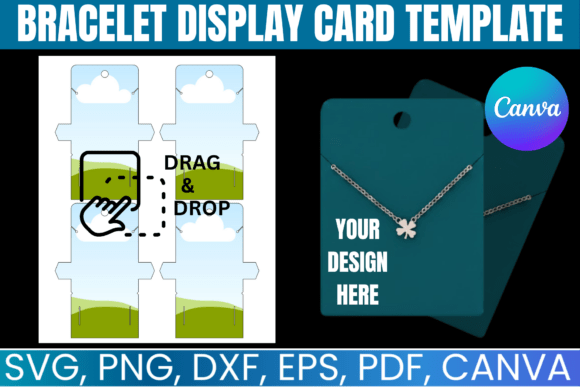
For a recent client—a local artisan launching a summer solstice necklace collection—I needed display cards that felt cohesive across Instagram posts, product mockups, and printed hang tags. The Bracelet Display Card Canva Template delivered immediate visual cohesion. Its fold-over structure (a hybrid of Fold-Over Necklace Holder and minimalist card) works equally well for flat lay photography and shelf-ready presentation. It doesn’t compete with the jewelry—it frames it.
Where It Excels in Real Client Work
This template shines brightest when supporting packaging design, social media graphics, and printable design deliverables:
- Product mockups: Drop a PNG version onto a neutral background mockup—works flawlessly for Etsy product listings and Shopify banners.
- Editorial design: Use the layout grid to build consistent blog visuals or newsletter headers for a jewelry brand’s seasonal campaign.
- Cricut projects: The included SVG and DXF files scale cleanly for vinyl cutting—tested at 2", 4", and 8" with zero edge distortion.
- Print-on-demand: Paired with matte paper stock, the subtle texture translates beautifully—no pixelation, no bleed issues.
- Brand identity extensions: Repurpose the card’s border motif as a divider in lookbooks or as a watermark on digital ads.
It also integrates naturally with other design assets—I layered it behind a serif font headline for a vintage apothecary feel, then swapped in a bold sans serif for a contemporary capsule collection. The flexibility isn’t accidental; it’s baked into the layer naming and grouping logic inside Canva.
Where Caution Is Required
This isn’t a universal solution—and that’s honest design judgment, not a flaw. Avoid using the Bracelet Display Card Canva Template in:
- Minimalist corporate branding: Its tactile texture and soft edges clash with ultra-clean B2B aesthetics.
- Small-format applications: Below 1.5" height, fine-line details soften. Test at actual size before finalizing sticker designs or QR code labels.
- Low-contrast backgrounds: The subtle shadow under the fold won’t read on light gray or cream—always preview on your exact background color.
- Crowded layouts: It’s designed to anchor, not decorate. In dense flyer or poster compositions, it risks visual clutter unless isolated with generous padding.
Design Integrity Checks Every Professional Should Run
Before clearing this for a client project, I run these five checks:
- Black-and-white test: Convert to grayscale—does the hierarchy hold? Does the fold still read as dimensional?
- Contrast sweep: Preview on pure white, #f8f8f8, charcoal (#333), and dark navy (#0d1b2a). Adjust drop shadows if needed.
- Scale stress test: Zoom to 200% in Canva, then shrink to 25%. Check for jagged vectors or blurry PNG edges.
- Mockup realism: Place it on a real product photo—not just a stock mockup—with natural lighting and fabric texture.
- Licensing audit: Confirm commercial license covers all formats (SVG, DXF, PNG, Canva)—especially critical for print-on-demand sellers and Etsy product listings.
I also compare how it pairs with common font families: it sings with delicate script fonts (think handwritten font for gift tags), grounds bold display fonts (ideal for event signage), and adds warmth to crisp sans serifs (perfect for modern e-commerce).
Why It Earns a Spot in My Client Toolkit
In an era where audiences scroll past anything that feels templated, the Bracelet Display Card Canva Template succeeds by being both editable and intentional. It’s not a blank slate—it’s a thoughtful starting point. For a handmade business launching its first collection, it delivers instant credibility. For a digital seller juggling ten SKUs, it cuts production time without sacrificing brand voice. And for designers building scalable systems—not one-off graphics—it’s a rare example of a digital product that respects both craft and commerce.
It supports marketing visuals that feel human, not algorithmic. It elevates packaging design from functional to memorable. And when paired with strong photography and intentional typography, it quietly reinforces visual hierarchy, brand consistency, and emotional appeal—all without needing a custom illustration budget.
If you’re evaluating this for a real client project—whether it’s an Etsy product, a local event booth, or a seasonal campaign—ask yourself: does it serve the story the brand is telling? With the Bracelet Display Card Canva Template, the answer, more often than not, is yes.