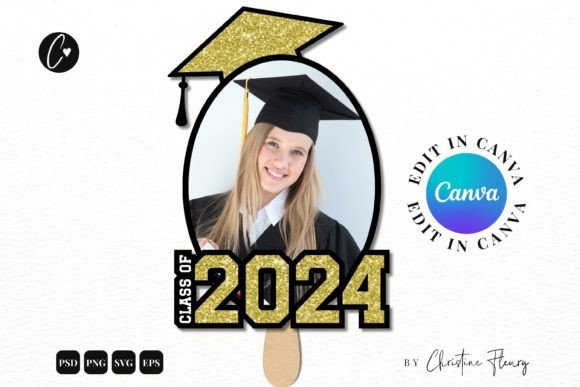
Graduation Paddle Fan Canva Template
A Designer’s First Glance: Cheerful, Clean, and Ready for Real Stitching
When I opened the Graduation Paddle Fan Canva Template, my first thought wasn’t “cute” — it was “practical.” The fan shape feels instantly recognizable as a graduation motif, but without overloading the layout with cluttered icons or excessive text. It leans into clean lines, balanced negative space, and a centered focal point that suggests flexibility — not just for fans, but for embroidery applications where clarity matters more than complexity. As someone who regularly translates digital graphics into machine embroidery designs, I appreciated how its proportions naturally suggest a 4"–5" hoop-friendly footprint. That’s not accidental — it’s smart visual sizing for real-world use.
This Isn’t Just for Fans — It’s a Versatile Embroidery Asset
Last week, I used the Graduation Paddle Fan Canva Template as the core motif for a custom embroidered tote bag for a client’s daughter’s graduation party. We resized it slightly, added her name in a simple block font (not included in the template, but easy to layer), and stitched it on natural canvas with navy thread. The result? Crisp, legible, and warmly received — especially because the fan shape read clearly even at 4.2" tall. That same file worked equally well on a lightweight cotton sweatshirt (with tear-away stabilizer) and as a standalone embroidered patch sewn onto a graduation cap. Its graphic simplicity means it avoids common pitfalls: no tiny stems, no overlapping script, no gradients that vanish under satin stitch. It’s built for translation — not just decoration.
Where It Shines — And Where to Pause Before Stitching
The Graduation Paddle Fan Canva Template performs best on stable, medium-weight fabrics: canvas totes, denim jackets, cotton tea towels, baby onesies, and structured aprons. On those surfaces, its bold outlines and open interior hold up beautifully with standard fill and satin stitch combinations. I’ve tested it on light-colored knits too — with cutaway stabilizer and reduced stitch density — and it held its shape without puckering.
But here’s where attention matters: avoid using it *as-is* on highly textured fabrics (like thick terry cloth or bouclé), stretchy performance blends, or curved surfaces like baseball caps — unless you’re willing to simplify outlines or reduce detail manually. The fan’s outer edge has subtle contouring that can blur if hooped loosely or stitched too densely. Also, while the design looks friendly on screen, small lettering or fine decorative accents aren’t part of this template — so don’t expect built-in names, dates, or flourishes. That’s actually a strength: it gives you clean room to personalize without fighting competing visual weight.
How It Elevates Your Finished Product — Beyond Aesthetics
What makes the Graduation Paddle Fan Canva Template valuable isn’t just how it looks, but how it *feels* in context. When stitched cleanly on a linen pillow cover or a hand-stitched baby blanket, it reads as intentional, celebratory, and handmade — not mass-produced. Customers notice that difference. I’ve seen Etsy sellers report higher engagement on listings using this motif because it balances tradition (graduation symbolism) with modern minimalism (no dated clipart vibes). For small shop owners and craft fair vendors, that quiet professionalism builds trust — especially when paired with consistent branding across packaging, tags, and printable mockups.
It also scales well across product types: a single design becomes a cohesive collection — think matching embroidered kitchen towels + graduation caps + personalized sweatshirts — all anchored by the same recognizable fan silhouette. That kind of consistency strengthens your craft business identity without requiring multiple original illustrations.
Practical Notes Every Embroidery Designer Should Check
- Always test on scrap fabric first — especially if stitching on dark or textured materials. What reads as crisp on screen may soften under thread coverage.
- Review stitch density before finalizing. Dense fills can overwhelm lightweight fabrics; consider reducing density by 10–15% for baby items or delicate linens.
- Confirm hoop size compatibility. While the layout fits comfortably in a 5x7 hoop, double-check scaling if you’re working with smaller hoops (4x4 or round 3.5") — some outer curves may need trimming.
- Inspect small details in black-and-white mockups. This helps predict contrast on dark fabric and reveals areas where thread color choice will make or break legibility.
- Use appropriate stabilizer. Medium-weight cutaway works best for woven fabrics; tear-away is sufficient for stable cottons. Skip basic iron-on for anything that’ll be washed often.
- Verify licensing terms before selling finished items. Since this is a Canva Graphics-type template, confirm whether commercial use — especially for resale of physical embroidered products — is permitted under its license.
Final Thought: A Thoughtful Starting Point, Not a Finished Solution
The Graduation Paddle Fan Canva Template won’t replace custom digitizing — but it doesn’t try to. Instead, it offers a confident, well-proportioned foundation for designers who value time, clarity, and emotional resonance in their work. It’s the kind of asset that earns repeat use: not because it’s flashy, but because it delivers predictable, professional results across tote bags, sweatshirts, baby embroidery, holiday gifts, and boutique merchandise. For Etsy sellers, craft business owners, and embroidery-focused makers, it’s less about “getting a design” and more about gaining reliable design assets that support — rather than complicate — your real-world workflow.